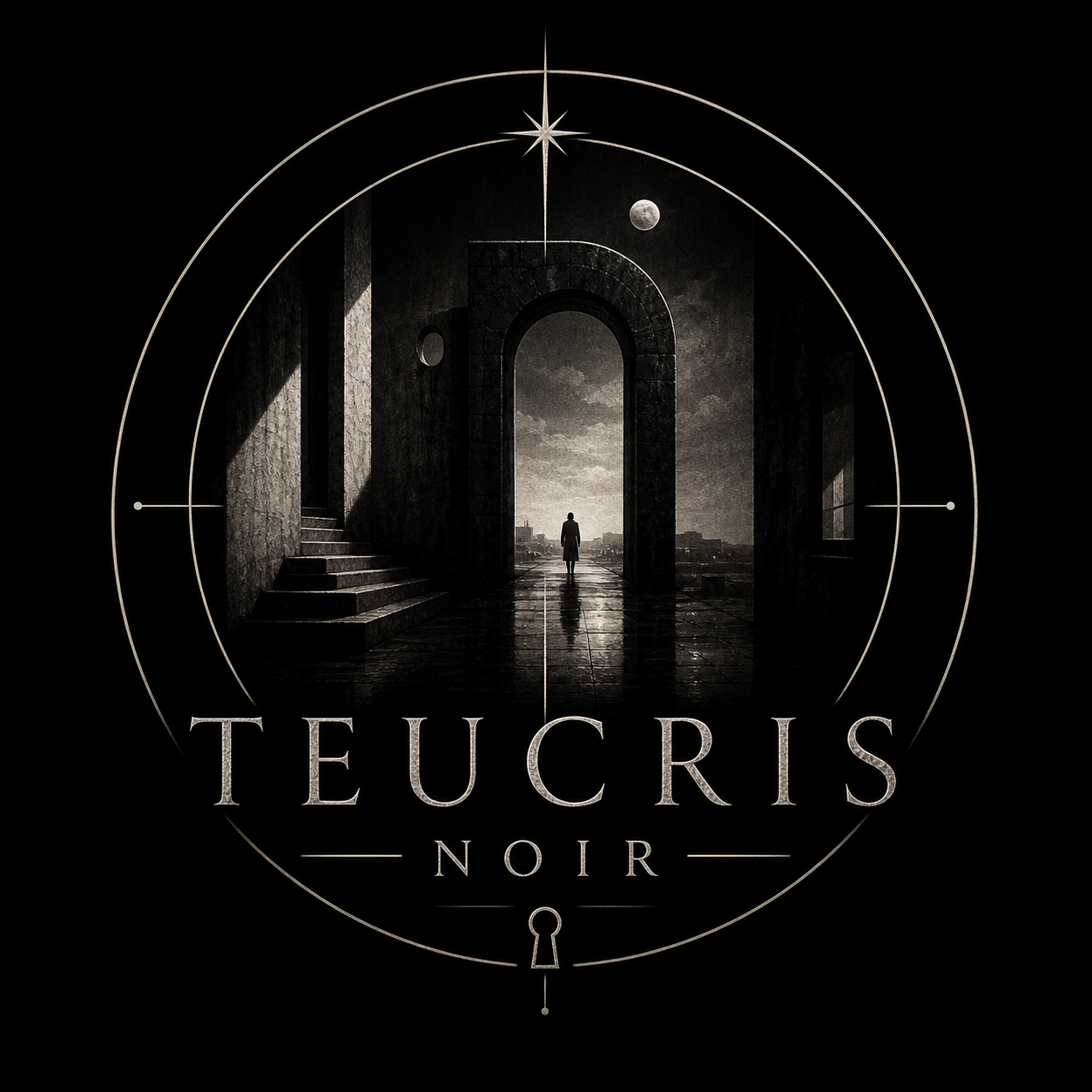
Teucris Noir is not a genre. It is not a style, a technique, or a school. It is a cinematic condition — a way of seeing the world through shadows, thresholds, and the quiet tremors beneath ordinary reality. Emerging from the crossroads of architecture, metaphysics, and underground European cinema, Teucris Noir treats the frame not as a window but as a ritual space, a chamber where the visible and the invisible negotiate their fragile coexistence.
At its core lies a simple conviction: the world is full of signs, but they rarely speak aloud. Teucris Noir listens to them.
A Cinema of Thresholds
Every image in Teucris Noir is built around the idea of the threshold — the doorway, the corridor, the mirror, the unfinished structure, the half-lit street. These are not backgrounds but active participants, places where the world seems to hesitate before revealing its deeper architecture. The camera does not rush. It observes. It waits. It allows the environment to breathe until the viewer senses that something is about to emerge, even if it never does.
This tension — the almost, the not-yet, the unseen — is the pulse of Teucris Noir.
Black and White as Ontology
Teucris Noir embraces black and white not as nostalgia but as metaphysical necessity. Color distracts; monochrome distills. Light becomes intention. Shadow becomes meaning. The absence of color is not a subtraction but a sharpening, a way of stripping the world to its essential contrasts: presence and absence, silence and sound, fate and choice.
In Teucris Noir, black and white is not an aesthetic decision. It is the natural language of the unseen.
The Ritual of the Frame
Every shot is constructed as a ritual gesture. The camera moves with deliberation, as if performing a liturgy. Characters rarely dominate the frame; instead, they inhabit it like visitors in a larger, older system. Their gestures are minimal, their silences heavy. Dialogue is sparse, not because words are unimportant, but because the world speaks first.
The frame becomes a container of forces — architectural, emotional, symbolic — that exceed the characters themselves. A wall is never just a wall. A shadow is never just a shadow. A pause is never empty.
Metaphysics in Everyday Spaces
Teucris Noir finds the metaphysical not in the supernatural but in the ordinary world charged with hidden significance. A construction site at dusk. A deserted stairwell. A car interior illuminated only by dashboard glow. A book left open on a table. These are portals, not props.
The aesthetic draws heavily from the lived environment of Patras and the broader Mediterranean urban landscape — cities where ancient stone and modern concrete coexist, where history is not past but sedimented into the present. Teucris Noir treats these spaces as repositories of memory and possibility, places where the visible world thins just enough to reveal the deeper currents beneath.
Silence as Narrative
In Teucris Noir, silence is not absence. It is the primary narrative force. It carries weight, intention, and emotional density. Silence allows the viewer to lean in, to sense the tension between what is shown and what is withheld. It creates a cinematic experience that is contemplative, atmospheric, and charged with latent meaning.
The result is a form of storytelling that does not explain but invites — a cinema that trusts the viewer to feel rather than decode.
Existential, Not Cynical
Although rooted in noir, Teucris Noir rejects cynicism. Its darkness is not moral but ontological. It explores the human condition through ambiguity, solitude, and the search for meaning in a world that rarely offers clear answers. Characters are not antiheroes but wanderers, seekers, individuals navigating the thin line between the tangible and the intangible.
The tone is existential, but never despairing. The darkness is a space of inquiry, not defeat.
A Cinematic Universe of Quiet Power
Teucris Noir is ultimately a cinematic universe defined by atmosphere, ritual, and metaphysical resonance. It is a world where:
- shadows carry memory
- silence is a form of speech
- architecture becomes destiny
- and every frame feels like a fragment of a larger, unseen story
It is cinema as invocation — a call to look deeper, to listen more carefully, to sense the tremors beneath the surface of things.
Teucris Noir does not ask to be understood. It asks to be experienced.

