Conceptual Documentary Cinema
TEUCRIS META-DOCUMENTARIES
We do not merely record what happened.
We examine what we believe happened — and what it means.
Traditional documentary usually begins with a subject. A Teucris Meta-Documentary begins with a question.
It may use real places, historical sources, archives, testimony, photographs, personal memory or cinematic reconstruction.
But its subject is not only the event. It is also the process through which the event becomes memory, narrative, interpretation — and ultimately cinema.
BEYOND DOCUMENTATION
Reality does not arrive on screen unchanged.
Someone chooses where to place the camera. Someone decides what will be filmed and what will remain outside the frame. Someone chooses the order of images, the music, the silence, the voice and the duration.
Meta-documentary acknowledges this reality instead of concealing it. It does not pretend that the camera is invisible. It treats the act of filming itself as part of the investigation.
THE QUESTION BEFORE THE SUBJECT
A Teucris Meta-Documentary may begin with a city, a historical incident, a person or a place. Behind the visible subject, however, lies a second level.
Not only: “What happened here?”
But: “How do we know it happened? What do we remember? What have we forgotten? What did we later add to the story? And what happens when the past can no longer provide a final answer?”
This is where meta-documentary begins.
FACT, MEMORY AND RECONSTRUCTION
Historical and factual evidence is the foundation. It is not always complete.
Archives contain gaps. Testimonies disagree. People remember differently. Places change. Sometimes the most important element of an investigation is precisely what is missing.
A Teucris Meta-Documentary may use conjecture, cinematic reconstruction or symbolic imagery — not to present fiction as fact, but to make visible the gap between what we know and what we are trying to understand.
THE FILMMAKER INSIDE THE FILM
In conventional documentary, the filmmaker often attempts to remain invisible. In meta-documentary, the opposite may occur.
The filmmaker’s research, doubt, personal relationship to the subject or even failure to find an answer can become part of the work.
The film does not present only the result of an investigation. It can film the search itself.
REALITY AS SYMBOL
A real place can acquire symbolic meaning. An object can connect the present to the past. An old photograph can be evidence and mystery at the same time. A gap in the historical record can become a dramatic event.
Documentary approaches essay; investigation approaches fiction; reality approaches conceptual cinematography — while keeping clear what is evidence, what is interpretation and what is cinematic construction.
SELECTED META-DOCUMENTARIES

Zalongo — After the Ending, Before the Termination
Historical memory, national myth and philosophical inquiry beyond the simple representation of a historical event.

Amalthea and the Salt
The real landscape of salt becomes the starting point for a conceptual journey through matter, myth and human presence.

Preveza — Karyotakis and THE Question
A city identified with a poet and a death is examined beyond the historical event.
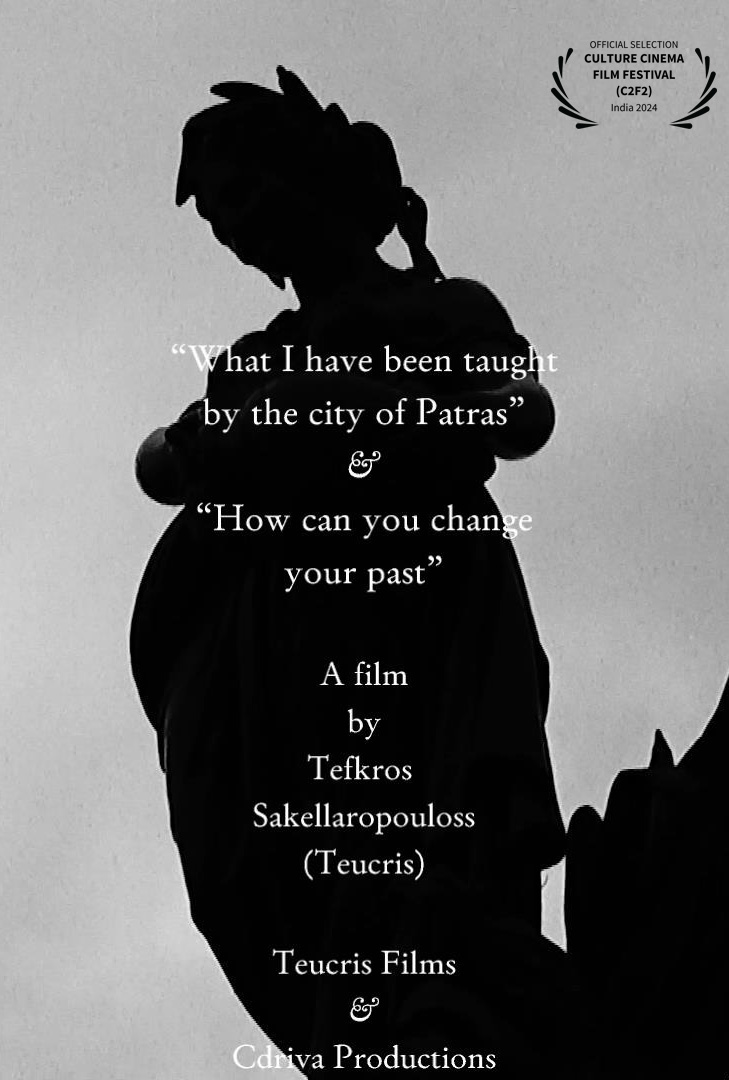
Tefkros’ Patras
The city becomes a personal and cinematic mechanism of memory.
THE TEUCRIS APPROACH
Teucris Meta-Documentaries exist at the intersection of:
documentation · personal essay · cinematic research · symbolism · memory · philosophy
They do not necessarily seek the large production. They seek the large question.
A real place, a small crew, a few people, archival material, one voice or a single object can be enough, provided that behind them lies a question worth investigating through cinema.
Teucris Noir is the creative identity. Conceptual Cinematography is the language. Meta-Documentary is one of the principal forms in which that language operates.
We do not begin with a story.
We begin with a question worth filming.